

An ECI Conference Series
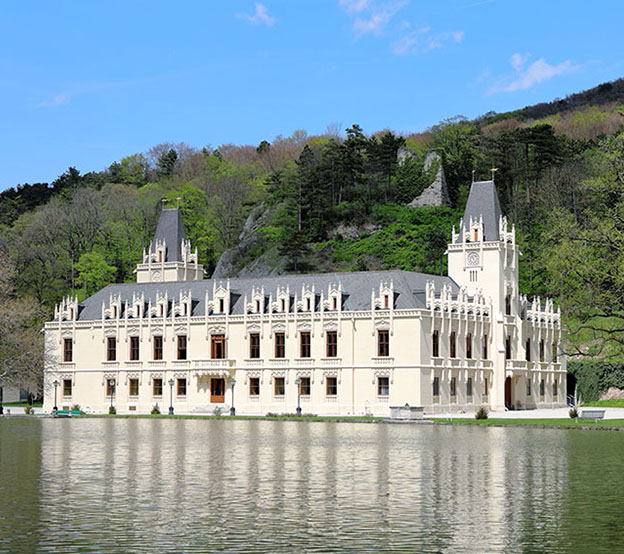
August 8-13, 2027
Hernstein (near Vienna), Austria
About This Conference
The conference on Mixed Conducting and Nonstoichiometric Compounds aims to bring together scientists from a wide range of disciplines working on oxides, nitrides, hydrides, chalcogenides, and mixed-anion compounds and other related materials. By fostering interdisciplinary exchange, the meeting will provide an international platform for discussing both the fundamental understanding and technological applications of nonstoichiometry and mixed conductivity in functional materials. The conference is designed to create an inspiring environment that promotes scientific discussion, collaboration, and innovation.
Traditionally, nonstoichiometry has played a central role in controlling the electrical, electrochemical, transport, and mechanical properties of functional oxides used in applications such as solid oxide fuel cells, sensors, permeation membranes, and electrochemical reactors. Today, the importance of nonstoichiometric materials has expanded considerably, encompassing emerging technologies including all-solid-state batteries, all-oxide electronics, optoionics, switching and memory devices, and magnetoresistive systems. At the same time, increasing demands from the semiconductor and energy industries have stimulated intensive research into nitrides, chalcogenides, and complex-ion compounds such as hybrid perovskites, further enhancing the significance and timeliness of this conference.
The scientific program will span topics ranging from the fundamental physical and chemical principles governing nonstoichiometric and mixed-conducting materials to advanced device concepts and their practical realization. Particular emphasis will be placed on emerging experimental and theoretical approaches that provide new insights into defect chemistry, transport phenomena, and structure–property relationships. By connecting researchers from chemistry, physics, materials science, and engineering, the conference seeks to stimulate new collaborations and accelerate the development of next-generation functional materials and devices.
The conference series on nonstoichiometric compounds has a long and successful history. The first conference was held in the early 1980s, establishing an international forum for researchers in the field. After a break of more than ten years, the series was revived in 1998 under the theme “Nonstoichiometric Ceramics and Intermetallics.” Since then, the conference has been held regularly every three to four years, with the most recent meeting, “Mixed Conducting and Nonstoichiometric Compounds VIII,” taking place in Tainan in 2024. Continuing this long-standing tradition, we look forward to organizing another stimulating and successful conference that will further strengthen the international community working on nonstoichiometric and mixed-conducting materials.
Topics
- Fundamentals
- Point defects and local structure
- Extended defects, interfaces and surfaces
- Transport properties
- Optoionics
- Applications
- Batteries
- Fuel cells and electrolyzers
- Memory and memristive devices
- Bioelectronics and optoelectronics
- Advanced Characterization
- High-resolution methods
- Time- and spatially resolved analysis
- Theory
- Artificial intelligence and machine learning for material design
- Atomistic modeling
- Continuum and device-level approaches
Conference Organization
Conference Chairs
Matthias (Max) Elm
University of Giessen
Germany
WooChul Jung
Seoul National University
South Korea

Nicola Perry
University of Illinois
Urbana-Champaign
USA
Technical Liaison
Manfred Martin
RWTH
Germany
Previous Conferences in This Series
Nonstoichiometric Ceramics and Intermetallics (1998)
Jules Routbort, Rudiger Dieckmann, and Thomas Mason
Kona, Hawaii
Nonstoichiometric Ceramics and Intermetallics II (2001)
Rudiger Dieckmann and C.T. Liu
Barga, Italy
Nonstoichiometric Compounds III (2005)
Manfred Martin, Thomas O. Mason, and Junichiro Mizusaki
Kauai, Hawaii
Nonstoichiometric Compounds IV (2009)
Han-Ill Yoo, Shu Yamaguchi, Juergen Janek, and Sossina M. Haile
Jeju Island, Korea
Nonstoichiometric Compounds V (2012)
Juergen Janek, Lorenzo Malavasi, Tatsuya Kawada, and Ryan O'Hayre
Sicily, Italy
Nonstoichiometric Compounds VI (2016)
Ryan O’Hayre, Juergen Janek, Yoshihiro Yamazaki
Santa Fe, New Mexico, USA
Nonstoichiometric Compounds VII (2019)
Hitoshi Takamura, Roger De Souza, Ryan O’Hayre
Miyazaki (Kyushu Island), Japan
Mixed Conducting and Nonstoichiometric Compounds VIII (2024)
William C. Chueh, Kuan-Zong Fung, and Hitoshi Takamura
Tainan, Taiwan
General Information About ECI
Engineering Conferences International (ECI) is a not-for-profit, global engineering conferences program, originally established in 1962 that provides opportunities for the exploration of problems and issues of concern to engineers and scientists from many disciplines.
The format of the conference provides morning and late afternoon or evening sessions in which major presentations are made. Poster sessions will be scheduled for evening discussion as well. Available time is included during the afternoons for ad hoc meetings, informal discussions, and/or recreation. This format is designed to enhance rapport among participants and promote dialogue on the development of the meeting. We believe the conferences have been instrumental in generating ideas and disseminating information to a greater extent than is possible through more conventional forums.
All participants are expected both to attend the entire conference and to contribute actively to the discussions. The recording/photographing of lectures and presentations is forbidden. As ECI conferences take place in an informal atmosphere - casual clothing is the usual attire.
Smoking is prohibited at ECI conferences and conference functions.